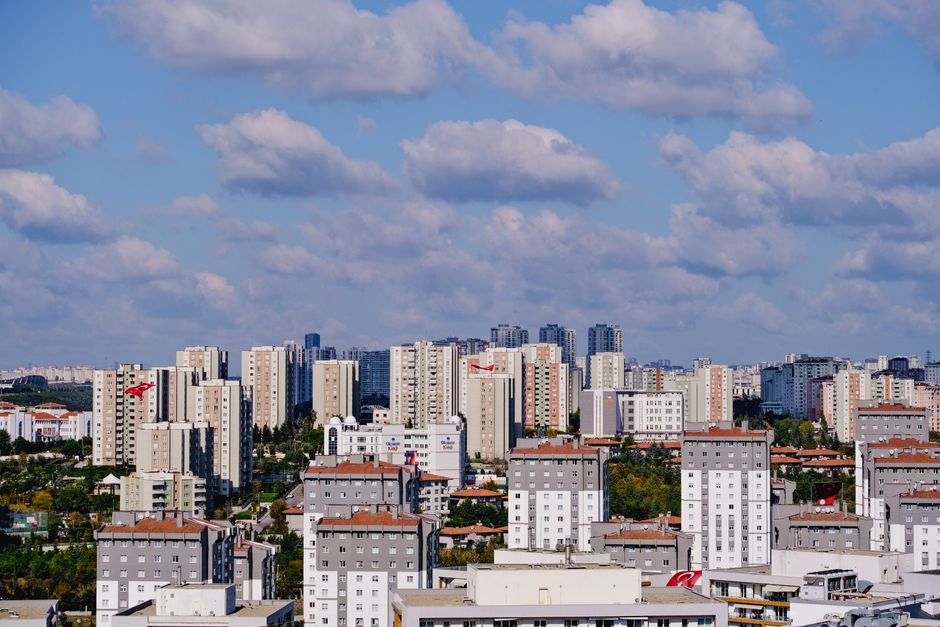
Istanbul's municipal planning authority issued approvals for more than 340 new residential and mixed-use projects in the first half of 2026, a figure that marks a 22 percent jump over the same period last year and signals a construction cycle picking up speed despite elevated borrowing costs. The projects span both sides of the Bosphorus, from Kağıthane in the north of the European side to Kartal on the Asian shore, and their collective floor area is expected to add roughly 2.8 million square metres of new stock to a city already straining under demand from foreign buyers chasing the citizenship-by-investment threshold.
The timing is not incidental. The Turkish lira has stabilised enough in 2026 to make dollar-denominated pricing legible again for overseas purchasers, and Istanbul's average transaction price is now holding around $2,500 per square metre across the city. That number masks enormous variation — premium units in Beşiktaş and Beyoğlu are clearing $5,000 per square metre in some schemes — but the underlying momentum is clear. Developers who sat on land banks through the inflation shock of 2022–23 are now moving.
The Districts Where the Permits Are Landing
Kağıthane, which sits just south of the Hasdal military zone and hugs the Golden Horn's upper reach, has absorbed the largest single concentration of new approvals: 67 projects totalling an estimated 620,000 square metres of residential floor space. The district transformed rapidly after metro line M7 connected it to Mahmutbey in 2021, and developers are now betting that the planned extension toward Gayrettepe — Istanbul's emerging central business district — will repeat that effect. Several mid-rise schemes on Gürsel Mahallesi's secondary streets are targeting the $180,000 to $250,000 price band, deliberately structured around the citizenship-by-investment floor of $400,000 per unit for foreigners while courting domestic buyers at entry level.
On the Asian side, Kartal is seeing a different kind of project mix. The coastal strip between Kartal marina and Pendik has attracted three large-scale master-planned schemes, one of them a 1,400-unit complex by a consortium involving Emlak Konut GYO, the state-backed real estate investment trust. That project broke ground in May 2026 and is scheduled for completion in late 2028. Prices in its first phase opened at $3,100 per square metre — significantly above the Anatolian side's historical discount to the European shore — a sign that developers are now treating the Asian coast as something closer to parity.
Kadıköy remains the benchmark. The neighbourhood's existing housing stock rarely trades below $3,500 per square metre for anything close to the waterfront, and new supply there is constrained by limited land and heritage conservation rules around areas like Moda and Bahariye Caddesi. The knock-on effect is that buyers priced out of Kadıköy are driving demand in adjacent Maltepe and Bostancı, which is exactly where some of the new project applications are landing.
Foreign Demand and the Citizenship Pipeline
Foreign nationals completed 18,400 property purchases in Istanbul in 2025, according to TÜİK data released in February 2026. Gulf buyers, particularly from Saudi Arabia and the UAE, accounted for roughly 35 percent of those transactions. The citizenship pipeline has not slowed — if anything, political turbulence elsewhere in the region, including the power transition now underway in Tehran following Ayatollah Khamenei's death, is pushing more Iranian buyers toward Istanbul as a hedge asset. Şişli, which already hosts a dense concentration of Iranian-owned businesses along Halaskargazi Caddesi, is seeing renewed apartment demand from that community specifically.
For buyers watching this wave approach, the practical reality is that pre-sale discounts — once 15 to 20 percent off list in slow markets — have narrowed to around 8 percent in the districts with the most active permit activity. Developers know the pipeline is liquid. Anyone expecting Kağıthane or Kartal prices to soften significantly before these projects complete is likely to be disappointed; the smarter move is to scrutinise delivery timelines and contractor track records before signing anything, given that Istanbul's construction sector has seen at least a dozen project delays in the past 18 months linked to materials costs. The permits are real. The buildings will take time.